Almost every conversation about weak car air conditioning starts in the same place: someone suggests topping up the gas. Sometimes that is genuinely what is needed. Frequently it is the equivalent of refilling a bucket with a hole in it and calling the hole fixed.
Why Lahore is harder on an AC than the manual assumes
A car air conditioning system is designed with margin, but that margin assumes conditions most of Lahore's year does not provide. Through May and June, afternoon temperatures sit in the forties. A car parked in open sun starts far hotter than the cabin the system was rated to pull down, and it is being asked to do that work while the engine is already fighting the same heat.
The bigger factor is airflow. The condenser sits at the front of the car and can only shed heat if air is passing through it. At speed that happens on its own - the car forces air through the fins. In stationary traffic nothing moves through it except what the cooling fan pulls. If that fan is weak, seized or running on a failed relay, the system keeps working perfectly at fifty kilometres an hour and quietly stops working on the Canal Road at five.
Then there is what is in the air. Lahore carries dust year-round and a serious smog season from roughly October to January, and both end up in the same two places: packed into the condenser fins where they block the airflow the system depends on, and loaded into the cabin filter where they choke the air coming out of the vents. A cabin filter here reaches the state a service schedule assumes at 20,000 kilometres a good deal sooner than that, which is why an AC can feel weak when nothing has actually failed.
How the system actually works
Automotive air conditioning does not create cold. It moves heat from inside the cabin to outside the car, using a refrigerant that changes state as it goes round. The compressor raises the refrigerant's pressure and temperature. The condenser, mounted at the front behind the grille, sheds that heat to passing air. An expansion device drops the pressure sharply, and the refrigerant boils in the evaporator behind your dashboard - absorbing heat from cabin air blown across it.
Two things follow from that. First, every stage depends on the correct refrigerant charge. Second, the condenser needs airflow, and the evaporator needs the blower and a clear filter. A fault anywhere in that chain shows up as the same complaint: not cold enough.
The common causes, roughly in order
1. A refrigerant leak
This is the most common cause of gradually declining performance. The system is sealed, so a low charge means a leak - typically at a hose crimp, an O-ring, the condenser after a stone strike, or the compressor shaft seal. Refrigerant carries the compressor's lubricating oil with it, so a system running low is also running short of oil. That is why driving on a weak system is genuinely damaging rather than merely uncomfortable.
2. Condenser airflow
If your AC is cold on the move but warm in traffic, look here before you look at gas. At speed, air is forced through the condenser. In traffic, the cooling fan has to do that job. A failed fan, a failed fan relay, or a condenser packed with dust, insects and road debris all produce exactly that speed-dependent pattern.
3. A blocked cabin filter
The cheapest and most overlooked cause. A cabin filter choked with dust restricts airflow across the evaporator, so the air that reaches you is limited in volume even though it is being properly cooled. In dusty conditions these clog considerably faster than the service schedule assumes.
4. Compressor or clutch faults
If the compressor clutch is not engaging, no cooling happens at all. That can be an electrical fault, a low-pressure lockout because the charge has dropped too far, or a failed clutch. A compressor cycling rapidly on and off usually points to a charge or pressure switch problem rather than the compressor itself.
Why a top-up is a temporary answer
Adding refrigerant to a leaking system does restore cooling, for a while. Then the same refrigerant escapes through the same hole, and you are back where you started, minus the cost of the gas. Worse, the DIY cans sold for this often include a sealant that can contaminate service equipment and, in some cases, the system itself.
The correct sequence is: measure the pressures, trace the leak with UV dye or an electronic detector, repair the leak, then evacuate the system, hold a vacuum to confirm it is sealed, and recharge to the manufacturer's specified weight - which is stamped on a label under the bonnet, not judged by feel.
What you can check yourself in five minutes
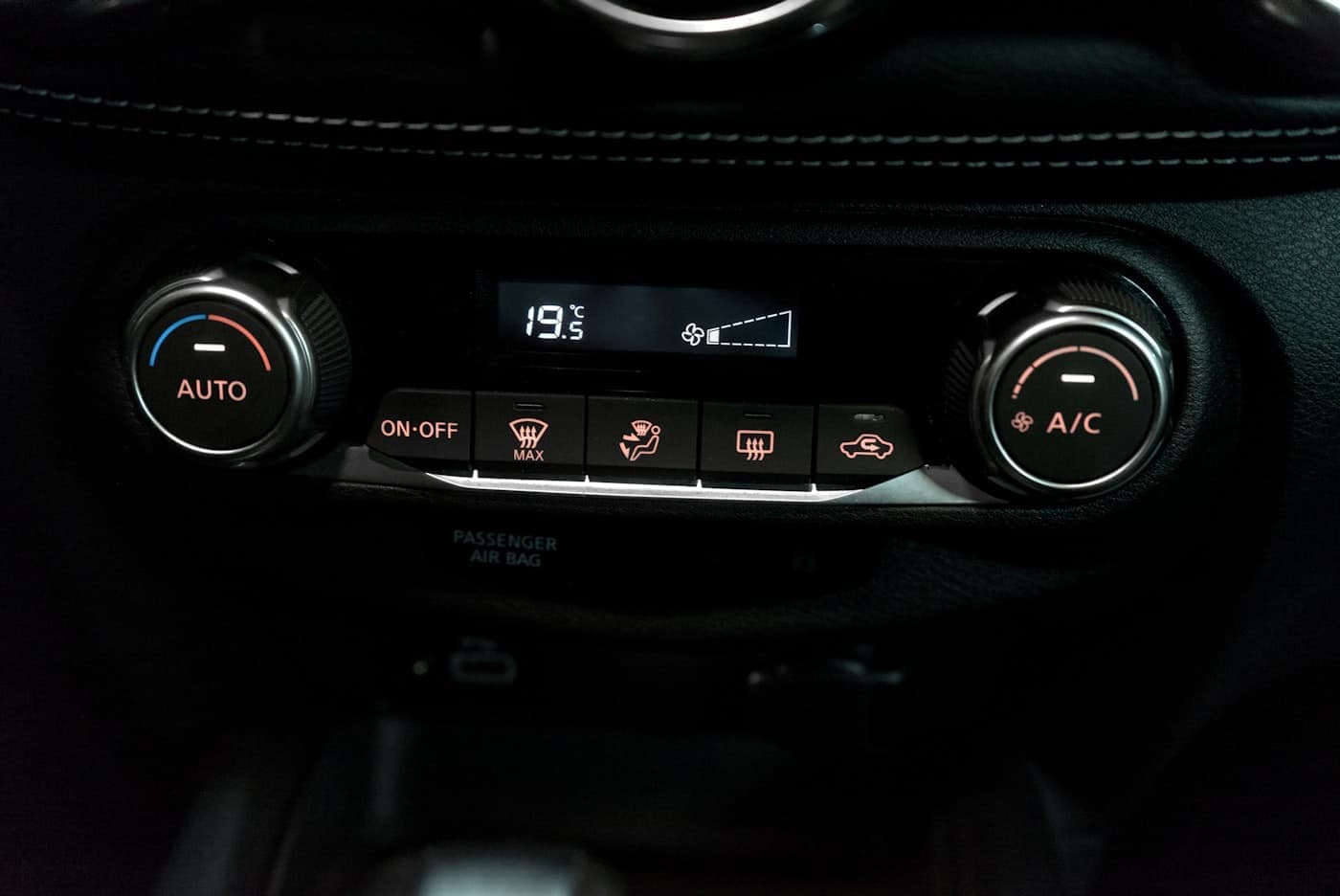
- Set the fan to maximum. If airflow is weak at every setting, suspect the cabin filter before anything else.
- Look through the grille at the condenser. If it is packed with dust and insects, that alone can cost you real cooling in traffic.
- With the engine idling and the AC on, look at whether the cooling fan is spinning. If it is not, that explains cold-on-the-move and warm-in-traffic exactly.
- Check for water dripping under the car after running the AC. That is normal condensate. Water inside the passenger footwell is a blocked evaporator drain.
If all of those look right and cooling is still weak, the system needs proper pressure testing. The answer to that is a diagnosis, not another can of gas.